
Content
Deeper insight into plant biology to support crop innovation and applied research.
Plants and other biological materials contain thousands of natural chemicals that can provide valuable clues about growth, resilience, quality, and responses to stress or environmental cues. At Vineland, we leverage plant metabolomics to measure and interpret these chemical profiles to support industry partners in understanding biological performance and make more informed decisions in crop development and innovation.
Backed by years of applied research experience, this innovation platform combines reliable metabolomic data with expert biological interpretation, helping turn complex chemistry into insight you can apply.
Image Text
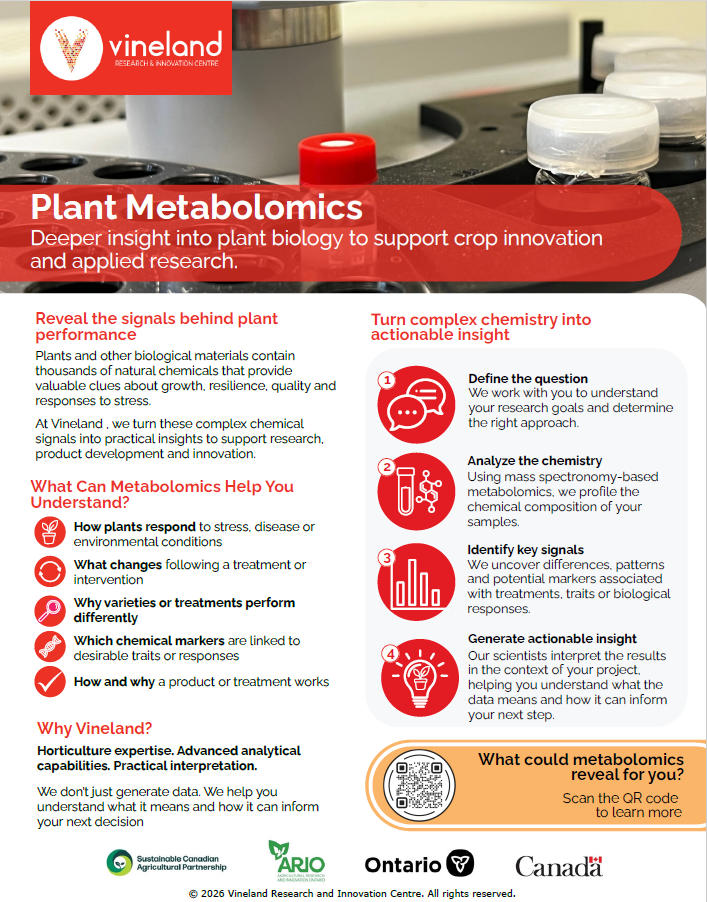
What Can Metabolomics Help You Understand?
How do plants respond biochemically to pests, diseases, beneficial microbes, and other biological interactions?
Can biochemical markers be identified to predict plant health, quality, or productivity before visible symptoms appear?
What is driving important traits such as yield, flavour, colour, shelf life, nutritional value, or stress tolerance?
What biochemical differences distinguish one variety or cultivar from another?
Which treatments, crop protection products, biostimulants, or growing practices produce the strongest biological response?
How do plants respond to environmental stresses such as heat, drought, nutrient limitations, or other production challenges?
Why is a crop underperforming under specific environmental or growing conditions?
Content
Rather than simply providing a raw metabolite dataset or a list of database matches, we help you understand what the results mean for your biological question.
Image Text
Flexible Metabolomics Solutions
Every project is different. Our team works with you to develop an approach suited to your research question, sample type, study design, and desired outcomes.
We can analyze a wide range of biological materials, including:
- Plant tissues, seeds, fruits, vegetables, and other crop materials
- Pest-, disease-, or stress-affected samples
- Fungi, bacteria, insects, and plant–microbe or plant–insect systems
- Soil, growing media, water, run-off, and hydroponic solutions
- Biostimulants, extracts, food and fermentation products, and horticultural by-products
Support can range from exploratory or proof-of-concept studies to larger, more complex research programs. We can also assess unusual sample types, specialized analytical needs, and existing metabolomics datasets.
Project scope, analytical approach, sample requirements, deliverables, and scheduling are developed collaboratively following an initial discussion.
Not sure what approach you need? Contact us to explore what could work for your project.
Image Text
Who It’s For
This service supports organizations advancing plant science and crop innovation, including:
- Plant Breeding & Genetics Companies
- Agri-Tech & Input Companies
- Plant Health & Biologicals Companies
- Food & Beverage Companies
- Research Institutions & Universities
Whether you’re investigating stress tolerance, treatment effects, quality traits or physiological responses, metabolomic insight can strengthen your research and help inform next steps.
Typical Questions Clients Bring to Us
- Why is this crop performing differently than expected?
- Which treatment or growing practice produces the strongest biological response?
- What makes one variety outperform another?
- Which metabolites are linked to flavour, quality, yield, or shelf life?
- How are plants responding to stress, pests, diseases, or beneficial microbes?
- Can biomarkers be identified to predict performance before visible symptoms appear?
Why Work with Us
Scientific credibility meets applied crop expertise.
Proven metabolomics methodologies developed through long-term research
Expertise spanning plant science, biochemistry, mass spectrometry and natural product chemistry
Strong applied focus in horticulture and agriculture
Insight-driven reporting aligned with real research questions
A collaborative approach that treats each project as a scientific partnership